There's a pattern we've watched repeat for two decades: a homeowner installs a landscape full of thirsty exotics in November, it looks incredible until June, and by the second summer half of it needs replacing. The properties that still look designed in year five are almost always built on a native backbone.
Natives aren't a compromise. Planted well, they're the most beautiful option. And they get there with less water, less fertilizer, and far fewer storm losses. These are our ten most-planted natives across Fort Myers and Cape Coral.
Grasses & groundcovers
1. Muhly grass (Muhlenbergia capillaris)
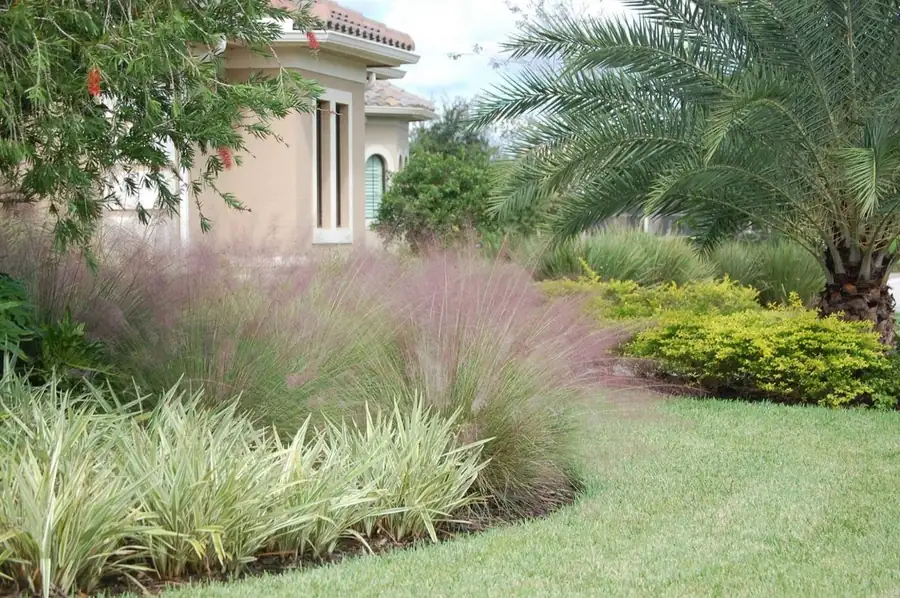
The show-off of the list. Fine green texture all year, then October arrives and it erupts into pink-purple clouds. Full sun, sandy soil, salt-tolerant. It was made for this county. Plant in drifts of five or more.
2. Fakahatchee grass (Tripsacum dactyloides)
The workhorse for larger beds: fountain-shaped, four to six feet, nearly indestructible. We use it to give young landscapes instant structure.
3. Dune sunflower (Helianthus debilis)
A sprawling groundcover with cheerful yellow blooms nearly year-round. Thrives in pure sand and full blistering sun. The strip between sidewalk and street that kills everything else? This is the answer.
Shrubs & structure
4. Coontie (Zamia integrifolia)
Florida's native cycad: neat, sculptural, and slow-growing enough that it never outgrows its spot. Handles deep shade to full sun, and it's the host plant for the rare atala butterfly.
5. Sea grape (Coccoloba uvifera)
The classic coastal broadleaf. Big paddle leaves with red veining, hedge or specimen tree, and total indifference to salt spray. Essential for canal and beach properties.
6. Silver buttonwood (Conocarpus erectus var. sericeus)
Soft silver-gray foliage that makes every green around it look richer. Beautiful as a screening hedge or a small multi-trunk tree, and one of the toughest coastal plants in Florida.
7. Simpson's stopper (Myrcianthes fragrans)
The native answer to boxwood hedging. Dense, glossy, fragrant white flowers, red berries that birds love. Takes shearing beautifully or grows naturally to a small tree.
Color & pollinators
8. Firebush (Hamelia patens)
Orange-red tubular blooms from spring until Christmas, hummingbirds and zebra longwings included. Cut it back hard each winter and it rebounds bigger.
9. Beautyberry (Callicarpa americana)
Unassuming all summer, then loaded with clusters of impossible-purple berries in fall. Perfect for the transition zones between manicured beds and natural areas.
10. Blanket flower (Gaillardia pulchella)
Red-and-yellow daisies that bloom essentially forever in full sun and sand. We use it for reliable color in dry spots that rarely get watered.
The honest caveat
"Native" doesn't mean "plant anywhere." Muhly grass sulks in shade; sea grape gets enormous; firebush needs room. The magic is matching species to the actual sun, soil, and salt on your lot. Which is precisely what a professional design is for.
Rule of thumb from our design team: build the backbone from natives, then spend your "risk budget" on two or three statement exotics you're willing to pamper.
Want a native-smart palette matched to your property? Request a free design consultation. We'll walk your lot and tell you exactly what would thrive there.